Posts

HONOR THY FATHER (Erik Matti, 2015)

Image
There are great films, and there are really great films. Erik Matti's "Honor Thy Father," from a script by Michiko Yamamoto belongs to the latter. The film doesn't only feature a career-defining performance from John Lloyd Cruz, but functions as well as a macro analysis on religious fanaticism, fraud and ultimately, the Philippines as a predominantly patriarchal society, at least as what the film suggests. In fact the concept of patriarchy figures prominently in our cinematic history, like in Marilou Diaz-Abaya's "Karnal" and Mike De Leon's "Kisapmata." Coincidentally, the late Vic Silayan happened to portray the father in said films, an authoritarian brute whose word is law in both instances.  Or even in contemporary cinema, such as in Jun Lana's "Barber's Tales," where male figures rule basically all aspects of society. Another example is Mike Tuviera's "The Janitor," where blind obedience to o...

BUY NOW, DIE LATER (Randolph Longjas, 2015)

Image
In a film festival that has come to be associated with ridiculousness in recent years, "Buy Now, Die Later" arrives as a much-needed breath of oxygen. The film turns the horror-comedy genre on its head, while also remaining faithful to a moral resolution sans the preaching. "Buy Now, Die Later" benefits greatly from a strong, tightly-wound script, and in the horror genre, where tropes and cliches perpetuate themselves, innovation is key. Five equally interesting characters are linked by a mysterious shopkeeper named Santi (TJ Trinidad), who provides them with objects that will grant their hearts' deepest desires.  Segmented into five interdependent stories, "Buy Now, Die Later" uses the five senses as its jump off point, designating one per character and allowing each of them to be slowly terrorized by their own sources of pleasure. The film still contains familiar horror tropes (zombies, cannibals, puppet masters, haunted objects) yet...

TANDEM (King Palisoc, 2015)

Image
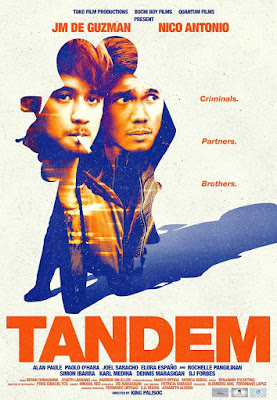
"Tandem" could have been another generic tale about urban crime, but screenwriter Zig Marasigan, working from a story by Mikhail Red, and director King Palisoc inject the film with a solidly grounded conflict between two brothers- the elder an ex-convict with a clear-cut set of newfound morals, while the younger a thrill-seeker who wants to earn his brother's respect, that the story rises above the trappings of the genre. Roman (Nico Antonio) and Rex (JM De Guzman) earn a living from robbing other people. Equipped with a motorcycle, guns and their sense of brotherhood, the two prowl the streets of Metro Manila looking for the next big score. Roman has a baby on the way with his wife Cha (Rochelle Pangilinan), while Rex is madly in love with a bar girl named Nadine (Elora Españo). As we begin to see the brothers on a human level, suddenly they cease to exist as mere criminals. They are now survivors.  Yet the film does not glorify or justify the incidence ...

KAKABAKABA KA BA?- RESTORED (Mike De Leon, 1980)

Image
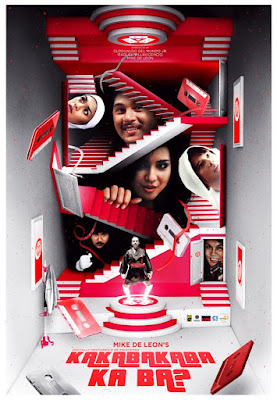
English title: Does your Heart Beat Faster? A film like Mike De Leon's outrageous musical "Kakabakaba Ka Ba?" would have never been made today. Equal parts a mystery film, a comedy, a social criticism and a bizarre descent into the unknown, De Leon and co-writers Raquel Villavicencio and Doy Del Mundo unleash one maddening sequence after another, culminating in a finale that now stands as one of Philippine cinema's most iconic moments. Everything begins on familiar territory. A Japanese (Buboy Garovillo) tries to smuggle contraband into the Philippines, but miserably fails every single time. (If this is not predictive of current airport woes in NAIA, I don't know what else to call it.) In his latest attempt, he hides the contraband inside a cassette tape, and slips it into the jacket of an unwitting co-passenger named Johnny (Christopher De Leon). The contraband goes through customs, undetected. (Again, another mockery of local airport security which st...

LOVE (Gaspar Noé, 2015)

Image
"Love" is the latest film from France-based Argentinian filmmaker and provocateur Gaspar Noé, and surprisingly, it is also his tamest, despite the slew of onscreen full-frontal nudity and overlong hardcore sex scenes. Told in a non-linear fashion similar to Noé's previous films, "Love" tells of American film student named Murphy (Karl Glusman), who is torn between the love of his life, Electra (Aomi Muyock) and the mother of his child, Omi (Klara Kristin). The story unfolds as if an ambivalent surge of memory; Murphy recalls the good and the bad, but for the most part, the unrelenting sex. In one scene, Murphy questions why no one has ever depicted "sentimental sexuality" on film, which is Noé trying to state the obvious. "Love" succeeds when it strips down its main character of his pretensions; it fails when Noé has to justify the film's reason for being, which he does so a number of times during the film's 135-minute ru...

ANINO SA LIKOD NG BUWAN (Jun Lana, 2015)

Image
* English title "Shadow behind the Moon" The best term to describe Jun Lana's latest film would be a cinematic charade- a game of identities, of motives, of suppressed passions, and of uncertainty. Or the film equivalent of a Russian doll, if you will. "Anino sa Likod ng Buwan" only has three characters- husband and wife Nando (Anthony Falcon) and Emma (LJ Reyes) and military man Joel (Luis Alandy). What started as a seemingly routine banter among friends gradually and intensely escalated into an examination of society, where the definition of immorality is blurred during a time of insurgency.  And in fact, the film does discuss the subject of immorality from various paradigms. When does adultery become acceptable, and to whom? Is sexual liberation more heinous than murder? Why is immorality always a double standard? The film plays out the ideas in endless games. Or are they really games at all? Lana could have stopped there, but he didn...

TAKLUB (Brillante Mendoza, 2015)

Image
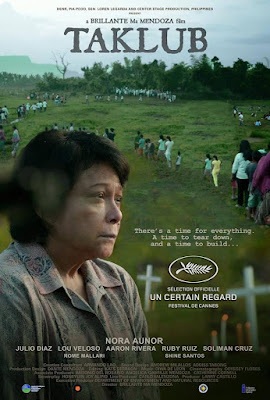
English title: "Trap" Tragedy is a very delicate subject matter for film. If done inappropriately, the filmmaker is prone to either sensationalism or emotional detachment. "Taklub" borders closer on the latter. The film opens with a tracking shot of the typhoon Yolanda aftermath in Tacloban, and cuts to a fire consuming one of the refugee tents in the makeshift "Tent City" community. People scamper to put the fire out with pails of water, as we see a familiar figure emerge in the dizzying darkness. It is Nora Aunor, who plays one of the displaced residents during the storm. Filmmaker Brillante Mendoza exhibits early on his penchant for visual irony, when a fire causes the death of an entire family of storm survivors, sans the patriarch. Fire, as opposed to water. Water, which is supposed to give life, yet caused the deaths of thousands.  Slowly, "Taklub" introduces us to its assortment of characters. Bebeth (Aunor) runs a run...